

Application of Circular Staplers in Laparoscopic Surgery
Over the past few decades, medicine has witnessed a major transformation in surgical techniques. While major operations once required large incisions, numerous sutures, and prolonged hospitalization, the emergence of laparoscopic surgery has fundamentally changed the course of treatment.
Laparoscopic surgery, also known as Minimally Invasive Surgery, allows surgeons to perform complex procedures through several very small incisions, usually between 0.5 and 1 centimeter, by inserting delicate instruments and a specialized camera called a laparoscope into the body. Procedures such as partial removal of the intestine, stomach, uterus, gallbladder, and even tumor surgery can be performed with minimal tissue damage.

This method not only helps reduce pain and the duration of hospitalization, but also decreases bleeding and the risk of infection while allowing patients to return to their daily activities more quickly. For this reason, laparoscopy is now recognized as a gold standard in modern surgery.
However, the success of these surgeries does not depend solely on the skill of the surgeon. The instruments used during the procedure also play a vital role in accuracy, safety, and the final outcome. One of the most important of these instruments is the Circular Stapler, a device that may appear simple but is, in practice, a key factor in the success of many gastrointestinal surgeries.
What Is a Circular Stapler and Why Is It Important in Laparoscopic Surgery?
A circular stapler is a mechanical instrument designed to connect or rejoin two tubular sections of tissue, such as the intestine, rectum, or esophagus. In this process, known as Anastomosis, the stapler places rows of fine metal staples to connect the two ends of the tissue while simultaneously cutting away the excess tissue between them. This reconstructs the passage through the organ in a uniform manner and helps prevent leakage.
Simply put, a circular stapler performs the same task that surgeons previously carried out manually with sutures and considerable time, but with greater precision, in much less time, and with lower risk.
In laparoscopic surgery, the use of high-quality staplers not only increases surgical efficiency but also helps prevent serious complications such as anastomotic leakage, bleeding, and postoperative infection.
The Role of Circular Staplers in Surgical Success
Surgical experience and the selection of appropriate instruments are two fundamental pillars of every successful operation. Differences between stapler brands can determine the accuracy of device performance, staple quality, compatibility with different tissues, and ultimately patient safety.
Reputable brands in this field generally offer patented technologies, strict quality control, ergonomic design, and technical and educational support for surgeons. In contrast, the use of low-quality brands may result in incomplete staple formation, tissue leakage, or even the need for repeat surgery. Such situations can be dangerous for the patient and challenging for the surgeon.
Among the leading global manufacturers of surgical staplers are brands such as Ethicon, Medtronic (Covidien), and GoldenStapler.
Main Components of a Circular Stapler
The main components of a circular stapler include:
1- Main Body (Handle): Contains the compression and firing mechanism.
2- Shaft: The tubular section that is inserted into the body through an incision or trocar during surgery.
3- Head: The stapling section where the staples are located.
4- Anvil: A movable component positioned opposite the head that helps close the staples by compressing the tissue.
5- Safety Lock: Designed to prevent accidental or unintended firing.

Steps for Using a Circular Stapler
The steps for using a circular stapler in colon or rectal anastomosis include the following:
1. Preparation and Inspection of the Device
- Before use, the surgeon must ensure that the stapler is physically intact, the moving parts operate smoothly, and the blade and staples are undamaged.
- The appropriate stapler size, usually 21, 23, 26, 29, or 32 millimeters, is selected according to the diameter of the intestine or the surgical site.
- It must be confirmed that the anvil and the main body are fully compatible and can be securely locked together.
2. Tissue Preparation
- First, the two ends of the tissue that are to be connected, for example the two ends of the intestine or stomach, are carefully cut to ensure clean edges without necrotic tissue.
- Minor bleeding is controlled and the tissue edges are positioned appropriately.
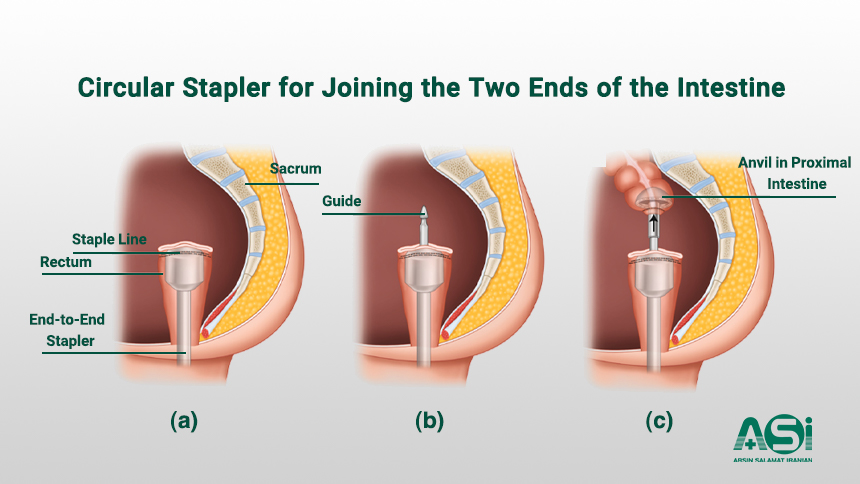
3. Insertion of the Stapler and Anvil
- The anvil is usually introduced into the target area through the mouth, anus, or a surgical incision, depending on the location of the surgery.
- The main body of the stapler is inserted from the opposite side so that both components are positioned facing each other.
- The Center Rod of the stapler is connected and locked to the anvil. This causes the two ends of the tissue to be compressed evenly between the head and the anvil.
4. Compression and Tissue Alignment Check
- The surgeon slowly rotates the device handle to bring the two ends of the tissue closer together.
- Precision is extremely important at this stage. Excessive compression may crush the tissue, while insufficient compression may result in leakage.
- Once the appropriate distance is reached, the device is locked to keep the tissue stable.
5. Firing
- The stapler is activated by pressing the Trigger.
- In a single action, hundreds of small metal staples are placed in a circular pattern in the tissue while the internal blade simultaneously cuts away excess tissue.
- The result is a clean, secure, and leak-resistant circular connection between the two ends of the tissue.
6. Inspection of the Anastomosis
- After removing the device, the two complete rings of excised tissue should be inspected. The presence of complete tissue rings indicates that the connection has been formed correctly and completely.
- The surgeon performs a leak test by injecting air or fluid to confirm complete closure.
7. Completion of Surgery and Confirmation of the Final Result
- The surgical area is irrigated, bleeding is controlled, and drainage is placed if necessary.
- After surgery, the patient is usually monitored for 24 to 48 hours to ensure proper functioning of the anastomosis.
Key Points When Using a Circular Stapler
- Selecting the appropriate stapler size: A mismatch between the stapler diameter and tissue diameter is one of the causes of postoperative leakage.
- Gradual compression before firing: This helps remove blood from the tissue and reduces tissue damage.
- Complete inspection of the tissue rings removed by the stapler: If they are incomplete, the anastomosis may also be incomplete.
- Single-use staplers must not be reused.
- Proper training of the surgical team: Each brand has its own specific design. For example, GoldenStapler staplers feature a double-lock mechanism and a color-coded compression indicator for more precise pressure control.
Differences Between the Use of Circular Staplers in Laparoscopic and Open Surgery
In open surgery, the surgeon has direct access to the anastomosis site, and the stapler is used under full direct visualization. In laparoscopy, however, the device is inserted through trocars and small incisions. Therefore, specialized laparoscopic models with a slimmer design, greater length, and an adjustable-angle handle are required. Brands such as GoldenStapler have developed dedicated laparoscopic versions that help prevent damage to surrounding tissues and provide better access and visibility for the surgeon.
GoldenStapler: A Leading Manufacturer of Minimally Invasive Surgical Instruments
Golden Stapler Surgical Co., Ltd. is a leading company in the design and manufacture of minimally invasive surgical instruments. It was established in China in 2007. By focusing on the development of circular, linear, and curved staplers as well as equipment related to laparoscopic surgery, the brand has become a recognized name in Asia and international markets.
GoldenStapler products include a wide range of disposable staplers, devices specifically designed for hemorrhoid surgery such as PPH and STARR models, and accessories such as Trocars and tissue retrieval bags.
The company holds international certifications including ISO 13485, and some of its products have also received FDA 510(k) clearance, demonstrating compliance with global safety and quality standards.
Key features of GoldenStapler staplers include:
- Precise design suitable for laparoscopic and open surgery
- Uniform distribution of staple pressure to help prevent leakage
- Sharp blades made from durable alloys for clean tissue cutting
- Multiple sizes from 21 to 32 millimeters to accommodate different surgical conditions
- Competitive pricing compared with American and European brands
By combining technology, strict quality control, and educational services for surgical teams, GoldenStapler has established a valuable position among global brands and is used in many hospitals worldwide as a reliable and cost-effective option.
Leave a Comment
We appreciate you sharing your feedback and helping us continuously improve the quality of our services.
* Your email address will only be used to respond to you and will not be published.